In my last blog post I discussed how artificial intelligence large language models does not replace the challenging work of mastering a topic or a skill. This leads into my biomechanics and orthotics learning pathway.
When teaching students, I am often asked how I acquired my understanding of biomechanics and orthotics. My answer is that it was a gradual process. Here was my process. This is a history of podiatric biomechanics teaching in Ontario.
When I entered the Michener Institute’s Chiropody School in 1983, the curriculum reflected a transitional moment in the profession. Much of Ontario’s chiropody education still carried the imprint of the UK model shaped from the 1960s through the late 1970s:
- Pathology‑first thinking, not mechanics‑first
- Footwear, padding, and accommodation as primary interventions
- Hospital‑based practice integrated with rheumatology, geriatrics, and diabetes care.
- Cautious adoption of Root‑style functional biomechanics
- A focus on posture, deformity, and pressure relief, rather than formal gait mechanics
This was the footcare model Ontario inherited from the UK: medically adjacent, conservative, and orthopaedically influenced, but not yet the mechanically driven, orthotic‑focused model that would later define North American podiatry.
Michener in the 1980s: A Hybrid Curriculum
Michener sat at the crossroads of two traditions:
- the UK‑influenced clinical paradigm, emphasizing pathology, footwear, and accommodation.
- the emerging U.S. biomechanics revolution, led by Root, Shuster, and later Kirby and Dananberg
Our training involved learning how to manually cast, construct, and refine orthotics. Each student produced 10–15 orthotics for patients at the Toronto General Hospital Foot Clinic. But the mechanical theory behind those devices was still evolving.
Root’s subtalar neutral model was entering the curriculum, but it was not yet dominant.
We were the first generation to straddle both worlds.
Group Mentorship: Classmates and Colleagues Who Shaped My Thinking
My classmates and colleagues played a huge role in my development. We tested orthotic modifications on each other. We challenged the assumptions we had inherited and explored the emerging U.S. models that were reshaping the field.
Those informal study groups, hallway conversations, and shared clinical puzzles formed a collective mentorship that shaped my reasoning as much as any formal course. Collaboration drives professional progress, and collaborating with my colleagues deepened my grasp of biomechanics by inspiring me to consider fresh viewpoints and adopt a more analytical approach.
My first pivotal moment came in 1985 after graduation, when my classmate David Kerbl and I attended a two‑week biomechanics course at the California College of Podiatric Medicine in San Francisco. This is where I first met Kevin Kirby and Ron Valmassy, an experience that profoundly influenced my biomechanics trajectory.
Early Teaching Foundations: Toronto General Hospital (1988 -1991)
When I began clinical instruction at Toronto General Hospital in 1988, I saw the UK paradigm and the U.S. paradigm collide in real time.
Clinical instruction still leaned heavily on:
- accommodation
- pressure redistribution
- footwear modification
- pathology‑driven care
But our patients increasingly presented with sports injuries, mechanical overuse, and gait‑related pain, problems that demanded more than accommodation alone. This is where the gradual implementation of U.S. biomechanics began to take hold.
Teaching forced me to articulate what I knew and refine what I thought I knew. Those early years at TGH were when I first discovered the satisfaction of helping future clinicians feel biomechanics rather than just memorize it.
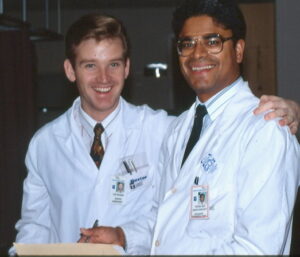
Peter Guy at TGH Foot Clinic 1991 with student Ian Wilson
Mentorship in Teaching (1988-1993)
A pivotal part of my development as an educator came through Paul Finch, whose mentorship shaped how I teach biomechanics today. Paul had a rare ability to take complex mechanical concepts and translate them into clear, clinically relevant teaching moments. His influence helped refine my approach to instruction by emphasizing clarity, structure, and practical application. I also had the influence of colleagues from the UK such as Mark Bradley and Graham Curryer who started teaching at TGH in 1990.
Standing on the Shoulders of Many (1985- present)
The leaders who helped lay the groundwork for U.S. biomechanics as it gained recognition have shaped my viewpoint.
- Merton Root
- Kevin Kirby
- Howard Dananberg
- Richard Schuster
- Ron Valmassy
- Richard Blake
- Paul Scherer
- Sheldon Langer
- Justin Wernick
- Russel Volpe
- Jeff Root
- John D’Amico
- Daryl Phillips
- Craig Payne
- Doug Richie
Each contributed a different piece of the puzzle: mechanical theory, clinical reasoning, gait interpretation, orthotic design, tissue‑stress modelling, and the integration of biomechanics into everyday practice. I had the fortune to attend two John Weed Seminars via Rod Tomczak DPM MD. I also attended numerous PFOLA conferences, which shaped my approach to teaching biomechanics and orthotics in the 1990s and 2000s by providing valuable structure, terminology, and mechanical insight.
The Role of Paris Orthotics
Another pivotal moment is my long association with Paris Orthotics since 1999, led by Paul Paris and Chris MacLean. This relationship also deepened my knowledge about the manufacturing process of custom foot orthoses and the importance of specialised devices like the Adult Acquired Flatfoot device.
Their engineering‑driven approach reinforced a core principle:
An effective orthotic is not only prescribed, but also carefully designed.
Part 1 Takeaway
Ontario chiropody training originated with a British approach, but the influence of North American biomechanics grew thanks to mentorship, collaboration among peers, and learning from early U.S. pioneers. The chiropody profession in Ontario was evolving and so was I.