By the 1990s and into the 2000s, biomechanics had become central to both my clinical work and my identity as a teacher. I had immersed myself in the theories of Root, Kirby, Dananberg, Schuster, Scherer, and others. I understood orthotic design, posting strategies, and tissue-stress modelling. On paper, the framework felt complete.
Yet in practice, something continued to trouble me.
Some patients improved exactly as the models predicted. Others did not. Often, the patients who failed to respond were those with rigid feet, stiff joints, chronic compensations, and long-established patterns of dysfunction.
That was when the realization became unmistakable:
Stiffness was the missing piece.
When Theory and Clinical Reality Diverged
One of the early influences on my thinking was Howard Dananberg, whom I first met in 1991. He played a significant role in advancing our understanding of how in-shoe pressure measurement could inform the prescription of foot orthotics. He had also written extensively about sagittal plane blockages, particularly involving FHL, and about the use of joint manipulation.
In 2000, I visited his practice in New Hampshire and observed his protocols for prescribing foot orthoses using two camera synchronous gait analysis and modifying trial foot orthoses using Fscan in-shoe pressure data. I witnessed how he incorporated manipulations of the ankle, cuboid, and first MPJ into his clinical approach. He was a strong advocate for facilitating motion through orthotic therapy.
That visit was a genuine turning point for me.
For the first time, I saw clearly that biomechanics was not only about alignment, force, and design. It was also about whether the foot possessed enough available movement to respond to those forces in the first place.
At that stage, however, I was not yet comfortable performing mobilisations and manipulations myself.
Discovering the Missing Link
That next step came later, and it changed my clinical practice profoundly.
In 2006, I met Rue Tikker, a podiatrist from California and a classmate of Merton Root. Learning the Hiss–Tikker Method of mobilisations and manipulations proved to be a major turning point. Once I began incorporating it into practice, I realized how much had been absent from my earlier, purely mechanical model.
Traditional biomechanics often assumes that if alignment can be measured, forces modelled, and the correct orthotic prescribed, the foot will respond accordingly.
But patients do not behave like theoretical models.
They present with:
- stiff midfoot complexes
- restricted first MTP joints.
- locked cuboids
- rigid rearfoot mechanics
- soft-tissue guarding
- years of compensatory movement patterns
At some point, I had to confront a simple truth:
you cannot post your way out of stiffness.
Rue often said, “Comfort varies directly with function.” That principle, drawn from his mentor John Martin Hiss, DO, MD, stayed with me because it captured exactly what I was beginning to see in clinic every day.
Why Manual Therapy Changed My Thinking
Manual therapy did not replace biomechanics for me. It completed it.
1. Stiffness distorts biomechanics
A joint that cannot move cannot load properly. A foot that cannot pronate cannot absorb shock effectively. A first ray that cannot plantarflex cannot contribute fully to propulsion.
Before mechanics can be corrected, motion must first be restored.
That realization marked a significant shift in my clinical reasoning.
2. Orthotics work best when the foot can respond
Orthotics are force-guiding devices, not force-creating devices. If the foot is too restricted to move, the orthotic has little opportunity to influence function in a meaningful way.
Manual therapy helps create that opportunity. It can:
- free a joint
- reduce guarding.
- restore available range.
- allow the orthotic to guide motion rather than compete with restriction.
Once I began to view orthotic therapy and manual therapy as complementary rather than separate approaches, my results became more coherent and more predictable.
3. Manual therapy can accelerate clinical change
Patients often feel the difference quickly: a smoother gait, improved dorsiflexion, and fewer compensatory patterns. Restrictions that once seemed fixed begin to change.
That immediate response can be both clinically useful and highly reassuring for patients.
4. It reconnects clinicians with the tactile side of practice
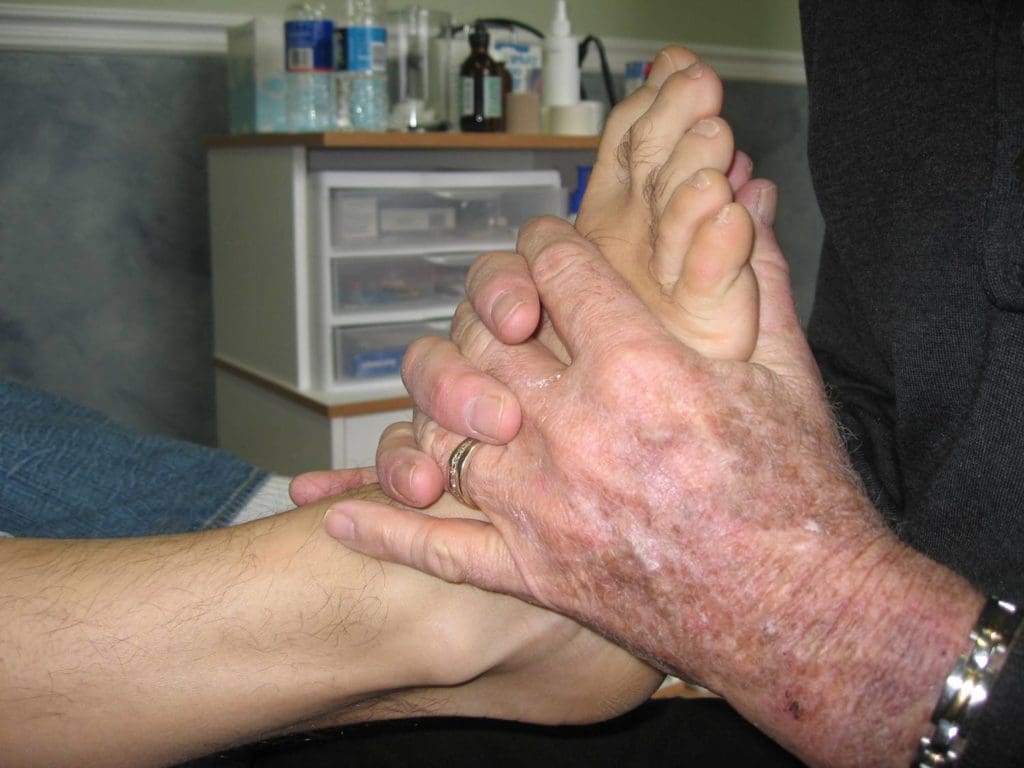
Biomechanics can become highly abstract. We can spend hours discussing force, structure, and motion planes. Manual therapy brings us back to the physical reality of the foot: the glide of the talus, the spring of the midfoot, the release of the plantar fascia.
It reconnects theory to touch.
And that matters.
From Foundations to Friction: Bridging Part 1 and Part 2
By the early 1990s, my biomechanics education felt complete — at least academically. I had trained within the UK pathology-first tradition, crossed into the emerging North American mechanics-driven model, and learned from many of the individuals shaping modern foot biomechanics. I could teach the language of biomechanics clearly and apply it systematically in clinic.
But over time, clinical practice exposed a quiet dissonance between theory and outcome. Some patients improved exactly as predicted. Others, particularly those with long-standing dysfunction, rigid feet, or deeply ingrained compensatory patterns, did not. The models were sound, and the orthoses were well designed, yet the feet themselves were not responding as expected.
What I eventually recognized was that my learning pathway, though biomechanically thorough, had overlooked a critical variable: movement capacity.
Mechanics assumed motion. Orthotics guided force. But too often, the tissues and joints I was treating could not move well enough for any mechanical intervention to succeed.
That realization changed my approach permanently.
It was the point at which biomechanics stopped being something I simply applied to the foot and became something I first had to unlock.
By 2015, this shift in thinking had become central enough to my practice that I began offering small-group workshops for chiropodists and podiatrists.
Teaching manual therapy has introduced me to the research of Luke Kelly, Gabriel Moisan, Chris Nester, and others investigating passive and dynamic stiffness. Their work will prompt clinicians to rethink foot and ankle function. In future blogs, I plan to examine this research and its continuing influence on clinical practice.
Because once I recognized stiffness as the missing piece, I could no longer ignore it.